Scientifically, this tiny arachnid goes by the name of Theridion grallator – but it takes little imagination to see how it got its more popular name: the happy-face spider.Found only in rainforests in the Hawaiian islands, the spiders have a vast range of patterns and colours on their abdomens – yet all come from the same species.The amazing diversity is due to genetic variations, although the patterns may also change depending on diet. The patterns may have developed as a way of confusing predators. The moment it takes an aggressor to work out whether the spider is prey or not provides a vital chance of escape.However, the species, which was discovered in 1973, is now under threat from the introduction of non-native animals to the islands.The most common form – or ‘morph’ – is plain yellow and has no smile. But other variations are plentiful – the ‘red front’ morph pictured here with a cluster of her eggs is the second-most common.
  The spiders are 5mm (less than a quarter of an inch) long and live alone on the underside of leaves – except during their mating season and for the first 40 to 100 days of spiderlings’ lives, when they are still too young to fend for themselves.The happy-face spiders feature in the new BBC2 documentary series South Pacific, which starts at 8.30pm tonight.
More than a thousand new species have been discovered in the Greater Mekong Region of Southeast Asia in the last decade, according to a new report from WWF.Among the 1,068 new species discovered between 1997 and 2007 were the world’s largest huntsman spider, with a leg span of 30 centimetres, and the hot pink cyanide-producing 'dragon millipede'.Most species were discovered in the largely unexplored jungles and wetlands. However, the Laotian rock rat, thought to be extinct 11 million years ago, was first encountered by scientists in a local food market.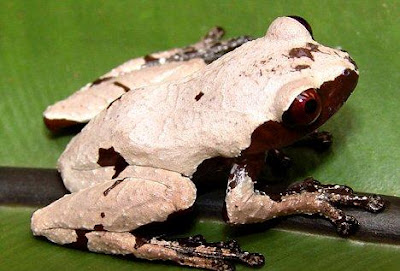 The Siamese Peninsula pitviper was found slithering through the rafters of a restaurant in Khao Yai National Park in Thailand.'This region is like what I read about as a child in the stories of Charles Darwin,' said Dr Thomas Ziegler, Curator at the Cologne Zoo.'It is a great feeling being in an unexplored area and to document its biodiversity for the first time… both enigmatic and beautiful,' he said.The findings, highlighted in First Contact in the Greater Mekong report, include 519 plants, 279 fish, 88 frogs, 88 spiders, 46 lizards, 22 snakes, 15 mammals, 4 birds, 4 turtles, 2 salamanders and a toad.
 The region comprises the six countries through which the Mekong River flows including Cambodia, Lao PDR, Myanmar, Thailand, Vietnam and the southern Chinese province of Yunnan.It is estimated thousands of new invertebrate species were also discovered during this period, further highlighting the region’s immense biodiversity.'It doesn’t get any better than this,' said Stuart Chapman, Director of WWF’s Greater Mekong Programme.'We thought discoveries of this scale were confined to the history books. This reaffirms the Greater Mekong’s place on the world map of conservation priorities.'The report stresses economic development and environmental protection must go hand-in-hand to ensure the survival of the Greater Mekong's astonishing array of species and natural habitats.
 'This poorly understood biodiversity is facing unprecedented pressure… for scientists, this means that almost every field survey yields new diversity, but documenting it is a race against time,' said Raoul Bain, Biodiversity Specialist from the American Museum of Natural History.The report recommends what is urgently needed to protect the biodiversity of the region is a formal, cross-border agreement by the governments of the Greater Mekong.'Who knows what else is out there waiting to be discovered, but what is clear is that there is plenty more where this came from,' said Chapman.
 The patterns may have developed as a way of confusing predators. The moment it takes an aggressor to work out whether the spider is prey or not provides a vital chance of escape.
 The spiders are 5mm (less than a quarter of an inch) long and live alone on the underside of leaves – except during their mating season and for the first 40 to 100 days of spiderlings’ lives, when they are still too young to fend for themselves.


