The Scottish border town of Gretna Green has an influx of visitors, and not just the human kind.It seems locals and tourists alike just can't get enough of watching millions of starlings converge on the sky on sunset as the birds search for a safe place to roost.Hundreds of spectators have been treated to the amazing sunset display, which has left them mesmerised by the huge flock's sweeping aerial acrobatics.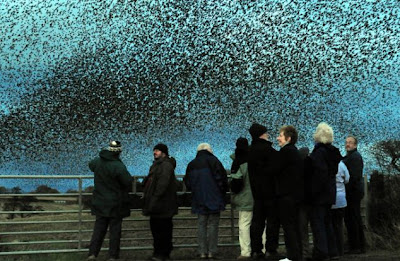 Drivers on the A74M, the main motorway between England and Scotland, have been stopping in their droves to witness the sight.But the shear mass of birds is causing a distraction to commuters and truck drivers who are urged to take extra care when pulling over and parking to watch the display.And while it may look like the birds are on a kamakazi mission, the logic behind their aerial acrobatics makes much more sense.Every winter, the birds take to the skies after a long day spent feeding in nearby reed beds.As they take flight during the last minutes of daylight, the starlings fly quick and fast in a bid to confuse waiting predators such as sparrowhawks and buzzards.
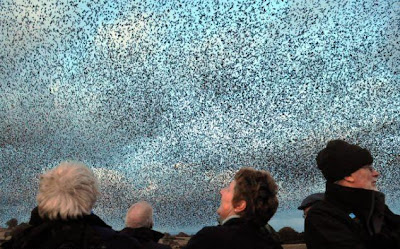 The tiny birds must converge, fly and sqwark, in an attempt to confuse their predators, reaching speeds of more than 20mph, with few if any crashes.Scientists say the secret behind their amazing spatial awareness is that each starling tracks seven other birds enabling the group's cohesion.The naturally occurring event is a spectacle which takes place only during the winter months.
 Starling numbers have halved in the last 25 years and they are now red-listed as an endangered species.Experts say the starlings are a mix of British and European birds and will leave for Russia in February and March.Nature lover Jon Tait, 34, said: 'It's amazing to see the natural world like this. The shapes and movements they make are beautiful - Hollywood special effects couldn't make it more breathtaking.'Whenever I get the train I have to dive undercover at the station when they come because they leave a bit of a mess, but it's worth it to see them in the sky.

A one-eyed, three-legged dog that won the title of world's ugliest pooch this summer has died.Gus, a Chinese crested dog, had cancer. He was nine years old.The animal was rescued from a bad home and went on to win the annual World's Ugliest Dog contest at the Sonoma-Marin Fair in northern California. Gus came from humble origins. According to the fair, his adopted family in Gulfport, Florida, rescued him after learning he was being kept in a crate inside someone's garage.He had one leg amputated because of a skin tumor and lost an eye in a cat fight.Gus' owner had said the prize money from the contest would be put toward the dog's radiation treatment.
Walking into the Cockrells' small, snug bungalow, set back from the main road on the outskirts of Great Yarmouth, is startling.Not because they've got the biggest TV I've ever seen. Or, as Jack is quick to point out, because they're halfway through a refurbishment and it's a bit dusty. Or even because it's so toasty warm.No, it's because there are cats everywhere. Wooden cats, plastic cats, metal cats, what look suspiciously like papier-mache cats, and 11 real cats, lolling around, fiddling about in their fleecy beds, stalking across the dining room table, tip-toeing over the computer keyboard and running up and down the slatted stairs to the attic extension. 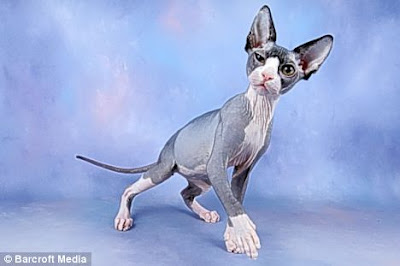 Oh yes, and none of them has any fur. At all. Which is rather unnerving, as they stare, pinky-grey and strangely unblinking, from all round the bungalow, every so often jumping down and playing with a toy mouse or a ball, or just generally pottering about, blissfully unaware of the drama that has been revolving around them in the Cat Fancy world.Because this is the hairless Sphynx cat. After nearly 40 years in the cat show wilderness and an awful lot of campaigning by besotted owners, it has finally been recognised as a breed by the Governing Council of the Cat Fancy - the feline equivalent of the Kennel Club. With the result that, as the GCCF put it: 'Sphynx cats will now be acceptable on our show benches.''About b****y time, too,' snorts Jack Cockrell, 62, a retired oil field consultant. 'It's a disgrace it didn't happen sooner. Just look at Darcy Bussell here - she's only eight months, but she's already championship material. Isn't she the most beautiful thing?'Not for nothing have Sphynx cats been described as the Marmite of cats - you either love them (very fiercely), as the Cockrells and all members of the Sphynx Cat Association do, or you give a shudder and stare rather rudely, as I do.
  It's hard not to, because they look extraordinary. You can see every bump and bone, every pimple and blemish. Their ears are enormous, their necks are so slim they look ready to snap in two, their eyes are HUGE. The faces look like something a special effects department has laboured over, their tummies are soft and rounded after lunch and their tails are long and rat-like.Even so, to Jack and Phyllis, 59, they're just perfect. 'They're so sociable and friendly - they'll sit on your lap and jump on your shoulder and ride around for ages like a parrot,' says Jack.'Of course they're totally mollycoddled, but they're nothing like normal pets. They're wonderful, but they do sort of take over.'Indeed.This is not the sort of pet you can placate with a tin of cat food and bowl of water. Oh no. These cats need a small and highly dedicated staff to cater for their peculiarities - most of which stem from their unnervingly smooth skin. For starters, they have a bit of a personal hygiene problem - without fur to absorb it, their skin can get rather oily. So there's the regular bath night, Phyllis's responsibility (Jack does the litter trays, and most of the chat), which involves a shampoo and scrub in the bath, a good clean of the ears, a nail trim and a rub dry with a warm, fluffy towel.The lack of a fur coat also means they need more protein to maintain their body temperature. So this lot are fed on £40 worth of top-quality biscuits, a couple of nice fresh roast chickens and 'a bit of fish or meat for a treat' each week.And there'll be no popping outside at night for a bit of mouse-catching and a miaow at the Moon, because they'd freeze to death in ten minutes on a cold November night. So they need to have plenty of toys and, ideally, a small indoor climbing frame and an owner with a lot of patience to keep them exercised and entertained.'We do sometimes put them in a harness and long lead and let them out in the garden in the summer,' says Jack. But only after they've been applied liberally with special suncream, obviously.The more you look at them, the more they look like some sort of weird prehistoric beast. But they're relative babies on an evolutionary scale.Hairless cats have popped up every so often all over the world since 1830, but the modern Sphynx descends from hairless kittens born in Canada in the Sixties and Seventies, after which they were exported to Europe.Twenty-five years on, the Sphynx finally have championship status and there's a whole Sphynxr-elated world out there. There are at least 25 certified breeders in the UK - operating under names such as No Coat On, Streakers, BuffNaked, Baldesque and Misfits - and dozens more further afield: America, Australia, Russia, Kazakhstan.
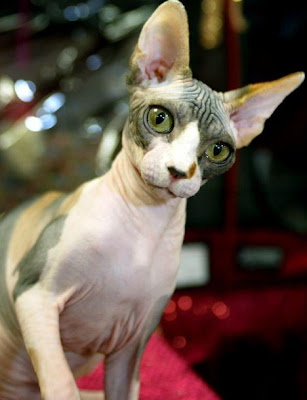 Kittens are shipped from country to country for breeding purposes.There are also countless websites, chat forums and goodness knows how many proud photographs of the strange-looking creatures posted on the internet.And while Jack and Phyllis might seem pretty obsessed - there are even four kittens mewling in a basket in their bedroom - they're nothing compared to some owner-breeders.Such as Kelly Hampton, 24, who lives in Wiltshire with her window-fitter husband Toby, 34, children Jake, seven, Elle-May, four - and 17 Sphynx cats.It all started for Kelly at a cat show four years ago.'I was with my grandma - we went past a pen and they had five pink, wrinkly babies in there and it was just like falling in love. I had to have one.'So she did, albeit after a wait - they cost £1,000-a-piece and talking round husband Toby took a while.Today, she has eight adults and nine kittens and the top floor of their three-bedroom home has been turned over to cats.'There are three different rooms because they can't all mix - so there's one for the girls, one for the stud boy, because he sprays a lot . . .' And a third for communal use, with a teeny brass four-poster bed with a leopard-print cover and cuddly toys.'I won the bed at a cat show. But it's a shame, because they don't like sleeping in it. They usually end up snuggling in with us - they're like little hot water bottles.'
 And while the Cockrells' cats are lucky to get a bath every couple of weeks, every Thursday is bath night chez Hampton.'And every other day I give them a little strip wash with a warm flannel. If you don't wash them, they can really smell. And their bedding needs washing every day, particularly if you have kittens.'Not forgetting all their outfits. Kelly's cats have quite a wardrobe - cat jumpers, teeny fleeces, pink hoodies. Once they're appropriately dressed, they go on the occasional outing.'I'll take them out for a walk on a lead or in their cat buggy - they need the extra layers because they lose heat so quickly. And they love going out in the car and putting their heads out of the window.'They are the most beautiful, amazingly loving cats I have ever known. They've changed my life for ever. And the odd thing is that I always thought I was more of a dog person.'Back in Great Yarmouth, Jack and Phyllis aren't in favour of dressing up. 'We might pop them in a sleeve of an old fleece if they're cold, but to me, anything else is making the cat look a bit silly,' says Jack.'It's not very dignified - a cat's a cat after all, not a designer toy.'And with that, he gathers up Darcy - or is it Dixie, Roy Orbison or Willie Nelson? It's difficult to tell - and pops her, or him, in my arms.'To me, their skin feels so warm and lovely, like a peach, or a deflated rubber balloon. What do you think?'Well . . . Darcy/Dixie/Roy certainly feels soft and warm - a bit like a horse's muzzle, but it's all a bit odd, too. And the moment I loosen my grip, she/he's off in a flash, leaving me with a face full of hairless tail and musty odour.So far, it's tricky to see the attraction. Or why are the owners - who are friendly and chatty and seem normal - so happy to act like the cats' slaves. Jack looks appalled at the thought.'They just love to give back the love. I tell you, if I'd have known about them 30-odd years ago, I wouldn't have had my children.'
 And then there are the shows. They may not have been recognised by GCCF until now, but other bodies, such as The International Cat Association, have been sponsoring Sphynx-friendly shows for a while.'Phyllis and I love the shows. We go every month, all over - Newbury, Tyneside, Milton Keynes, you name it. If we can come away with eight or ten rosettes, then we're elated.'There are no money prizes - 'just rosettes and points, and a lot of kudos - that's what it's all about'.Which is why this week's decision is so important. While the American TICA has lots of competitions, it is the GCCF that runs the Supreme Cat Show - the feline equivalent of Crufts, this year on November 22 - the jewel in the crown of pedigree cat shows.This lot could never be accused of not taking it seriously.'I want to breed more and more, to progress with the Sphynx lines,' says Kelly.With the Sphynx, the judges are looking for ear shape and set - ('large and open at the bottom and round at the top,' says Jack); the break between forehead and nose; the chin ('very important'); the number of wrinkles ('a wrinkly cat will do so much better'); and size ('they like a solid cat').Pedigree cats are on the up generally and breeders take it all very seriously, so gene components can be mixed and matched to produce refinements.Which leads to a darker note - according to one insider who'd rather not be named, the judges' tastes tend to push breeders towards extremes.'The current favourite for the Sphynx seems to be a shorter face, which can result in breathing and sinus problems. At the moment, it's not dangerous, but if things keep going that way, it has the potential to be,' says Kelly.There may be no cash prizes yet, but there's quite a bit of money involved. Mainly because of the huge demand.So while kittens for pets fetch £1,000 a piece, a 'breeder' will go for up to £4,000.Kelly has two litters under her belt already, a waiting list and will sell only to people she knows through her Sphynx contacts.Many of the Cockrells' customers are from overseas.'We've sent them to Portugal, America, Australia,' says Phyllis. 'The air fare to the U.S. for the cat was £500 - we both could have gone for that.''But we don't do holidays anymore,' says Jack.And what do their families think of it all? 'My children tolerate them, just,' says Jack. 'The grandchildren love them.'Meanwhile, I am trying hard to like the Sphynx cat, but I am failing miserably. It doesn't help that there are so many of them hovering about in one small, hot bungalow.As I take one last look at their strange faces and huge eyes, I am quite sure that, unlike Kelly, I'm going to stick to dogs.
Now Australian school teacher David Sheridan knows how Jonah felt - or near enough.As this amazing picture shows, a huge whale suddenly rose up close to the surface as the 42-year-old New South Wales man was riding his kiteboard - a small surfboard suspended beneath a large kite.Seconds after this photo was snapped remotely by David's camera, mounted on the kite apparatus, the whale flicked up its tail and gave him an almighty blow on the back of his head.Because the camera was programmed to take pictures every 10 seconds it missed the moment when the whale struck David - but this incredible shot of the massive creature swimming beneath him is reminder enough of his close encounter. 'It all happened so fast that all I could do was crouch down as the whale swam under me,' David said.'I saw the huge shape and my reaction was to duck while remaining attached to the flying lines from the sail above me.'The next thing I felt was its tail come up and hit me on the back of the head.'I honestly thought I was gone - it was such a forceful blow - but then the whale eased off and I was able to sail away.'But my legs were really shaking. I've never been through anything like that before and probably never will again.'David told Sydney's Daily Telegraph he had gone to Valla Beach, on the north coast of New South Wales, for an afternoon of kiteboarding with two friends.Because he wanted some unique photos of himself, he set up a camera on the sail that would haul him skywards so that he could then skim across the surface of the water - a dramatic sport that leaves beach-side spectators fascinated.'The camera was set to start firing off shots every 10 seconds as soon as I hit the water. When the sail was at full height the camera was about 25m above the surface.'It was a lucky shot to snap the whale as it came up underneath me.'It would have been great to have got a picture a second later when the tail came up and hit me in the back of the head, but you take what you get.'He said he believed the whale was content to scare him away, rather than lash out aggressively.'It was more of a push than a punch. I expected more.'Wildlife experts have identified the creature as a southern right whale, which gets its name from old-time hunters who believed the species were the 'right' whales to hunt because they were large, slow moving and floated when they were killed. They also provided large amounts of oil and bone.'Southern right whales are more unpredictable than humpbacks,' said Mr Jeff Ross of the National parks and Wildlife Service.'It's possible this one had a calf it was protecting, or was simply just reacting to the movement on the surface.'
There were no human bodies inside, but Merv Jones's home was truly a house of horrors.Every room in the three-storey terraced house was filled from floor to ceiling with an assortment of bric-a-brac and rubbish.The junk was even stacked in the hall close to the front door, making it almost impossible to get inside and both front and back gardens were a mess. After years of complaints from neighbours in Grimsby, council officials finally moved in to tackle the job of emptying the building.Incredibly they removed more than 100 tonnes of material, filling skip after skip after skip.The extraordinary amount and array of bric-a-brac was collected over decades by the eccentric 73-year-old owner.Old rifles, ammunition and swords were found inside, along with thousands of everyday items you would find at a car boot sale, such as dolls, electrical equipment, toys, pictures, books and ornaments.
 When asked about the clear-up Mr Jones said:'It's not pleasant living here. I wanted to clear it myself. I was trying to get it done.'The pensioner was put up in a hotel while his house was emptied and the North East Lincolnshire Council intends to reclaim the cost of the operation from him.Local residents regarded the property as a blight on their neighbourhood.Alyson Thomson, 58, a sales manager who lives next door, said:'It is hard to imagine how he did it, but I believe he was living in the house because I would hear his front door open and he would go inside and not come out until the next morning.'Every room was crammed from floor to ceiling with rubbish, it has been complete hell living next door to him for five-and-a-half years. I am horrified that he had a dog living there with him.
  There was a handgun, swords and nearly a dozen air rifles, they found propane gas and chemicals and they had to stop work whilst the fire brigade handles those chemicals.'I have been living next door to a potential bomb, filth and rats. On the day they started clearing he challenged me in the street saying "what have you been saying about me?"'I told him that he lived like a filthy pig and that was insulting to pigs and the police cautioned me saying they didn't want to provoke the situation.'He does not wash and wears his clothes until they stand up on their own. He has been collecting this stuff for 40 years.'No normal person would live like that so there must be something wrong with him. To me the house is unfit for human habitation.'Mrs Thomson said council officials clearing the huge amounts of rubbish found six skeletons of dogs. Windows upstairs shattered years ago and pigeons moved into the loft.Mr Jones originally ran a second hand shop in his street.He bought and sold a variety of household items as well as model engineering equipment, plant machinery and tools.The business has been closed for a decade, but the house nearby was crammed full of far more than simple 'left overs' from the business.The three-storey terraced house is privately-owned and in good condition would be worth at least £100,000.It took a team of council contractors and officials almost three weeks to clear the building.Mr Jones would sit on a bench nearby and watch his house being emptied into a succession of skips.Council officials are believed to be investigating two other addresses thought to be owned by Mr Jones and containing more bric-a-brac.It is not known what he intends to do with the house that has just been cleared.A warrant was granted at Grimsby Magistrates Court uner the 1936 Public Health Act which allows authorities to take control of 'filthy and verminous properties.'John Waite, the council's environmental enforcement manager, said he believed the house had no running water or gas and was unsure about where the electrical supply had come from.'Primarily this has been done for the welfare of the occupant, but also for residents.'Pest controllers were called in to lay bait for huge rats 'the size of small cats' living in the house and contractors were praised by neighbours.Tina Blanchard, 41, said:'It's awful, really horrible and they deserve a medal for the job they are doing.'
 A tree-living fungus that manufactures diesel fuel has been discovered in South America.Experts believe the organism, Gliocladium roseum, could potentially be a completely new source of green energy.The fungus, which lives inside the Ulmo tree in the Patagonian rainforest, naturally produces hydrocarbon fuel similar to the diesel used in cars and trucks.Scientists were amazed to find that it was able to convert plant cellulose directly into the biofuel, dubbed 'myco-diesel'.Crops normally have to converted to sugar and ferment before they can be turned into useful fuel.Professor Gary Strobel, from Montana State University in the U.S., said: 'G. roseum can make myco-diesel directly from cellulose, the main compound found in plants and paper.'This means if the fungus was used to make fuel, a step in the production process could be skipped.'Prof Strobel led an investigation into novel fungi in the rainforests of northern Patagonia, which cross the borders of Argentina and Chile.He found that when the diesel fuel fungus was exposed to potentially toxic antibiotics, it reacted defensively by generating volatile gases.'Then when we examined the gas composition of G. roseum, we were totally surprised to learn that it was making a plethora of hydrocarbons and hydrocarbon derivatives,' said Prof Strobel.'The results were totally unexpected and very exciting and almost every hair on my arms stood on end.'Cellulose provides the fibrous supporting structure of plants. During biofuel production, cellulose from plant waste is first treated with enzymes that turn it into sugar. Microbes then ferment the sugar into inflammable ethanol.Nearly 430 million tonnes of plant waste is produced from farmland each year around the world.Prof Strobel said: 'We were very excited to discover that G. roseum can digest cellulose. Although the fungus makes less myco-diesel when it feeds on cellulose compared to sugars, new developments in fermentation technology and genetic manipulation could help improve the yield.'In fact, the genes of the fungus are just as useful as the fungus itself in the development of new biofuels.'The discovery also questions our knowledge of the way fossil fuels are made. The accepted theory is that crude oil, which is used to make diesel, is formed from the remains of dead plants and animals that have been exposed to heat and pressure for millions of years.'If fungi like this are producing myco-diesel all over the rainforest, they may have contributed to the formation of fossil fuels.'The findings appear in the November issue of the journal Microbiology.
It is a distinction few people would want.But Hubble – branded Britain’s ugliest dog – is more concerned about burying bones and fetching sticks.Yet that didn’t stop his owners leaving the eight-year-old tied up in a wood a fortnight ago due to his less-than-handsome looks. Luckily the mongrel, who was left disfigured after being injured in his youth, was saved by bighearted animal rescue workers.And now they are looking to find the unsightly pooch a new, more loving owner – preferably someone who prefers personality to looks.Amanda Sands, the manager of the Dogs Trust centre in Leeds, said the black terrier-type cross looked even worse when he was first brought in.He had several rotting canine teeth and infected gums, which were removed and treated with antibiotics.She said: ‘Hubble is one of the strangest looking dogs I’ve ever seen but he makes up for it in personality. Even though he looks quite odd it kind of gives him a cute factor.‘He’s very loyal and just loves human company so he would make a brilliant best friend for that special person who can see past what he looks like.‘It’s a shame but ordinarily we would expect him to stay here for quite some time.‘People do tend to come and pick the cuter dogs. The others - our “sticky dogs” - can be here for months.‘Hubble is definitely a bit unusual but he’s a very sweet dog. It would be a shame if someone missed out on him because of what he looks like.'He’s a great little dog. ‘Hubble’s injury to his mouth appears to be an old one. He is not in any pain and is entirely healthy.
 ‘He would be best suited to a home with only adults or older children and no other pets, so he can be the centre of attention.Ms Sands said: ‘It’s sad but sometimes people do abandon pets who don’t look “normal”. It can be for a number of reasons and unfortunately that is one of them.‘I don’t think that Hubble is aware of his unusual looks. He’s confidence has grown every day since he arrived and we love him to bits.‘It will sad to see him go but we’re always overjoyed when one of our dogs goes to a good home.’The Dogs Trust has recently been hit hard by the credit crunch, with more people wanting to get rid of their pets and less people prepared to take them on.Ms Sands added: ‘We have about 100 dogs in at the moment, but if we had the room that would be hundreds.‘We have a waiting list full of people who tell us they want us to take in their dog.’ Anyone brave enough to adopt Hubble or find out more about the Dogs Trust can call 0113 281 4920.
It must be a nightmare for the ticket collector, but these Muslim pilgrims in Pakistan were still smiling as they clung on to a packed train.You can barely see the carriages because there are so many people and although it is common for 'passengers' ride on the roofs of trains and buses in Pakistan, even this level of 'outdoor' commuters is extreme for the country. The crowds were returning home at the end of the three-day Sunni Muslim festival in the ancient city of Multan.Organisers of the event claim is is the second largest gathering of Muslims in the world after the Hajj in the Holy city of Mecca, Saudi Arabia.The annual festival is organised by Dawat-e-Islami, which claims to be a non-political religous 'international propagational movement'.It says its principle objective is to preach and guide Muslims to act upon the teachings of the Holy Quran.
More than half of town halls admit using anti-terror laws to spy on families suspected of putting their rubbish out on the wrong day.Their tactics include putting secret cameras in tin cans, on lamp posts and even in the homes of 'friendly' residents.The local authorities admitted that one of their main aims was to catch householders who put their bins out early. The shocking way in which the Regulation of Investigatory Powers Act - an anti-terror law - is being used was revealed through freedom of information requests made by the Daily Mail.MPs and civil liberties groups last night accused councils of using the draconian powers for trivial reasons.Shami Chakrabarti of Liberty said: 'Snooping appears to have become the favourite pastime in town halls up and down the land.'Common sense has gone out of the window and instead of putting out more bins, councils spy on householders as if they were terrorists.'Tory communities spokesman Eric Pickles said: 'Under Labour, the rights and liberties of law-abiding citizens are being eroded through plans for ID cards, sinister microchip spies in bins and abuse of anti-terror laws by councils.'Taxpayers' money is being wasted on bankrolling an army of municipal bureaucrats who have watched too many episodes of Spooks.'The Mail requested information from all of the 474 councils in England. Of the 151 which replied, some 77 - more than half - said they had used the legislation in the last three years for suspected 'domestic waste, littering or fly-tipping offences'.Although it is ostensibly an anti-terror law, the Regulation of Investigatory Powers Act 2000, or RIPA, is worded so loosely that it can be used to justify surveillance operations for a variety of reasons.
 graphicThese include spying to 'protect public health' or the 'economic well-being of the UK'.This means that councils can use the powers granted by the Act to monitor families' treatment of household waste.In Lincolnshire, West Lindsey District Council uses the new powers to place motion-activated cameras on lamp posts to catch homeowners putting their bins out at the wrong time.One officer told an undercover reporter: 'In some areas, particularly where there is terraced housing, we have a problem with people putting their black rubbish bags out three or four days early.'When they have been left in alleyways or at the rear of terraced properties, it is difficult to identify exactly who has placed them there.'The cameras are hidden in tin cans or put on lamp posts and allow us to monitor who is coming out of which property and leaving their rubbish. Sometimes we are able to put these cameras inside peoples' homes that overlook the alleyways.Shami ChakrabartiShami Chakrabarti: 'Snooping appears to have become the favourite pastime in town halls up and down the land''These are usually residents who have complained to us about rubbish being dumped outside their house on the wrong day.'The council said it had been able to hand out 'several' fixed penalty notices on the basis of the evidence it had obtained.Officers at Southwark District Council also admitted that they had mounted cameras on lamp posts to spy on residents suspected of leaving rubbish out at the wrong time.The revelations have raised fresh concerns about the Home Office's plans to create a 'Big Brother' database of every citizen's e-mail and internet records.Ministers say that councils will not have access to the information.But critics point out that RIPA, which was passed as anti-terror legislation, is now being routinely used by town halls - and the same could happen with the database.Phil Booth, of the NO2ID campaign, said that public bodies were 'assembling the tools of a totalitarian state'.He added: 'We are no longer living in what most would recognise as a free society. This is not justifiable or proportionate.'Mark Wallace, of the TaxPayers' Alliance, said: 'It is crazy that so many councils are using anti-terror legislation to spy on their residents. It must cost a huge amount for all these concealed cameras, just to give a few people relatively low-level fines.'Other local authorities which gave details of how they used RIPA included Lewes District Council in East Sussex.It admitted that the Act was used to gain evidence on residents who persistently left rubbish out at the wrong time.South Bedfordshire council also admitted going through phone bills inside rubbish bags to identify who had left them outside.Officers also electronically tagged certain types of rubbish to find out if they had been dumped illegally.Wycombe District council in Buckinghamshire put an electronic tag on rubbish left outside a shop to see if it was taken.A spokesman for the Local Government Association, which represents councils, said: 'The LGA has written to councils to say that surveillance should not be undertaken unless it is absolutely necessary and proportionate to the crime that's being investigated.'Councils have a duty to protect their residents and are tuned in to the worries people might have about surveillance.'These powers are essential in making sure that benefits cheats, fly-tippers, rogue traders and other serious criminals are caught and brought to justice.'
In windows across Britain tonight, ghoulish faces, carved from pumpkins and illuminated by candles, will stare out eerily at passers-by.But while most are no more than two eyes and a toothy grin, Scott Cummins and Ray Villafane have taken their pumpkin heads to a whole new level - as these extraordinary pictures show.In just an hour or two of carving, slicing and gouging, and using everything from spoons and scalpels to garden spades, these incredible pumpkin Picassos can transform a humble Halloween gourd into a spitting image of Barack Obama or a Star Wars stormtrooper. 
 Using his background in high art and his work in designing models for D.C and Marvel comics, Ray, 39, has sculpted intricate faces out of the common pumpkin that make your hair stand on end.Based in the rural Michigan town of Ballaire, Ray's pumpkins have become something of an internet sensation, and include some familiar faces.His carvings, which include 'The Predator' and Barack Obama, also take in a wide variety of gothic gargoyles in keeping with the devilish theme of the popular American holiday.Using only common clay carving tools to create his Halloween pumpkin masterpieces, Ray explains how his artistic method works.
 'Not all pumpkins will look good and the most important thing about a pumpkin is it weight. You need to pick the meatiest pumpkin.'Sometimes I pick up a beautifully shaped pumpkin but when I pick it up I realise that it is not heavy enough. Its wall is just not thick enough for the carving rigours.'I also like a pumpkin with character. One with nobly ridges is good, so that I can utilise that in the carving procedure, like with sculpting noses,' says Ray.'The sculpting has always been a passion,' says Ray.'I used to be an art teacher for 13 years at a Michigan School called Bellaire school and one day I was approached for Halloween to do some pumpkin carving.'I thought why don't I try and carve the pumpkin like it is a piece of clay as opposed to a large vegetable.

 'It came out alright, but the most important result was that the kids at the school absolutely loved it.'I used to arrive at school and there would be a dozen pumpkins just sitting there waiting for me at my classroom,' explains the pumpkin carver.At the beginning Ray didn't always get the results he was looking for, resulting in a few fists through the front of the pumpkins.However, working for D.C comics, the home of Superman and Batman, Ray has honed his incredible seasonal talent.
 'Recently I have been really sitting down and giving my Halloween pumpkin designs more thought than usual due to the increased interest in my carvings.'Now that the thing has grown in popularity I am definitely feeling the pressure to deliver on the pumpkin front.'The most intricate pumpkin model that I have designed is 'The Predator' model, which took the best part of a day. Otherwise, the models take a couple of hours,' says Ray.Over the last two Halloween's Ray's pumpkins have begun to appear in online blogs and have really raised his profile.

 He has even made national television appearances and has been scheduled to appear on the US sports network ESPN where he is supposed to unveil his Barack Obama carving.Obviously, carving a potential president is a serious pressure, so Ray has to ensure that he gets it right.'If it is someone like Obama or even the Predator then I will have to use five or six images to make sure that I get the right details.
 'If it is something that I am creating myself then I will do it off the top of my head, like the skull and gargoyles,' says Ray.Around this time pumpkin carvings are usually a couple of triangles cut on the outside of the flesh, with his carvings Ray has seriously raised the bar to frightening levels.

This X-ray picture shows who a man who was shot in the head by a robber survived because the bullet lodged in his nose.Daniel Greenwood 'couldn't believe he was still alive' after the shooting at a house in Wythenshawe, Manchester. Doctors were able to remove the bullet but Mr Greenwood says he still suffers flashbacks, sleeplessness and headaches.He was shot while struggling with David Cummins who had tried to snatch a gold chain from around his neck.The pair were at the house with other people when the incident took place, Manchester Crown Court heard.Andrew MacIntosh, prosecuting, said Cummins, 21, had shown the others the 9mm handgun, which he put on a worktop before trying to grab Mr Greenwood's chain.Mr MacIntosh said Cummins was hit on the head with a claw hammer and then he and Mr Greenwood grabbed for the gun, which went off. The bullet hit Mr Greenwood in the face and lodged in his nose. Cummins, of Longlevens Road, Woodhouse Park, was given an indeterminate prison sentence after he admitted possessing the gun and robbery.The prosecution accepted he had not deliberately shot his victim, and that the gun went off during the struggle.
 But judge Mr Justice MacDuff told Cummins he must serve at least three and a half years before he could be considered for parole, adding: 'It was by good fortune he [Mr Greenwood] was not more seriously injured than he was.'Cummins, who had a string of previous convictions for robbery, fled Wythenshawe after the shooting.He was arrested by armed police in a hotel in Blackpool three days later. The gun still loaded was found in a sock.
Forget your run-of-the-mill Halloween pumpkin carvings, these incredible designs by American sculptor Ray Villafane have taken the annual ghoul-fest tradition to a different artistic level.Using his background in high art and his work in designing models for D.C and Marvel comics, Ray, 39, has sculpted intricate faces out of the common pumpkin that make your hair stand on end.Based in the rural Michigan town of Ballaire, Ray's pumpkins have become something of an internet sensation, and include some familiar faces.
 His carvings, which include 'The Predator' and Barack Obama, also take in a wide variety of gothic gargoyles in keeping with the devilish theme of the popular American holiday.Using only common clay carving tools to create his Halloween pumpkin masterpieces, Ray explains how his artistic method works.'Not all pumpkins will look good and the most important thing about a pumpkin is it weight. You need to pick the meatiest pumpkin.'Sometimes I pick up a beautifully shaped pumpkin but when I pick it up I realise that it is not heavy enough. Its wall is just not thick enough for the carving rigours.'I also like a pumpkin with character. One with nobly ridges is good, so that I can utilise that in the carving procedure, like with sculpting noses,' says Ray.
 'The sculpting has always been a passion,' says Ray.'I used to be an art teacher for 13 years at a Michigan School called Bellaire school and one day I was approached for Halloween to do some pumpkin carving.'I thought why don't I try and carve the pumpkin like it is a piece of clay as opposed to a large vegetable.'It came out alright, but the most important result was that the kids at the school absolutely loved it.'I used to arrive at school and there would be a dozen pumpkins just sitting there waiting for me at my classroom,' explains the pumpkin carver.
 At the beginning Ray didn't always get the results he was looking for, resulting in a few fists through the front of the pumpkins.However, working for D.C comics, the home of Superman and Batman, Ray has honed his incredible seasonal talent.'Recently I have been really sitting down and giving my Halloween pumpkin designs more thought than usual due to the increased interest in my carvings.'Now that the thing has grown in popularity I am definitely feeling the pressure to deliver on the pumpkin front.'The most intricate pumpkin model that I have designed is 'The Predator' model, which took the best part of a day. Otherwise, the models take a couple of hours,' says Ray.Over the last two Halloween's Ray's pumpkins have begun to appear in online blogs and have really raised his profile.
 He has even made national television appearances and has been scheduled to appear on the US sports network ESPN where he is supposed to unveil his Barack Obama carving.Obviously, carving a potential president is a serious pressure, so Ray has to ensure that he gets it right.'If it is someone like Obama or even the Predator then I will have to use five or six images to make sure that I get the right details.'If it is something that I am creating myself then I will do it off the top of my head, like the skull and gargoyles,' says Ray.Around this time pumpkin carvings are usually a couple of triangles cut on the outside of the flesh, with his carvings Ray has seriously raised the bar to frightening levels.


